
How to build flight hours quickly
Strategies for PPL and CPL candidates: time-building partnerships, cross-country planning, and splitting costs with other pilots.
Building flight hours is the most expensive part of becoming a licensed pilot. Here are proven strategies to accumulate hours faster without breaking your budget.
Understand what hours you need
Before planning a time-building strategy, know exactly what you need:
- **PPL:** 45 hours total (EASA); 45 hours (FAA)
- **CPL:** 200 hours total time; 100 hours PIC; 20 hours XC PIC
- **IR:** 50 hours XC as PIC (after PPL)
- **ATPL theory:** 1,500 hours total (frozen ATPL at 200 hrs)
Track your hours carefully. Know the gaps.
Time-building partnerships
The most cost-effective strategy: find another pilot at a similar stage, share rental costs 50/50, and fly together.
Both pilots log the flight. On a shared rental of €120/hr, you each pay €60/hr instead of €120. You fly twice as often for the same budget.
How to find time-building partners:
- AvioSharing time-building feature (coming soon)
- Your flying club's notice board
- PPL/CPL forums and Facebook groups
- Flying school peer networks
When flying with another pilot, agree in advance who acts as PIC for each leg. Alternate if both need the hours.
Plan efficient cross-countries
Cross-country hours are the most expensive to build because they require planning, fuel for longer legs, and landing fees at destination airports. Make them efficient:
- **Triangle routes:** Fly A→B→C→A to maximise distance with minimal dead legs
- **Combine with a purpose:** Visit an airfield with a restaurant (fly-in lunches are a GA tradition)
- **Use en-route alternates:** Plan routes that pass near interesting airfields where you can practice landings
- **Fly in the morning:** Most GA aircraft perform better in cool morning air, and early slots are cheaper at controlled airports
Night flying
Night currency requires 3 takeoffs and landings at night (every 90 days in the US; recent night experience required in Europe). Schedule dedicated night sessions:
- One 1-hour local flight can cover all 3 landings
- Shared with another pilot: ~€60 each
- Build night PIC hours efficiently
Instrument approaches for IR building
IR currency requires 6 instrument approaches every 6 months (in actual IMC or under the hood). Instead of flying solo, find a safety pilot:
- Safety pilot sits right seat, monitors for traffic
- PIC under the hood logs instrument time
- Both keep costs down by sharing the rental
Track everything
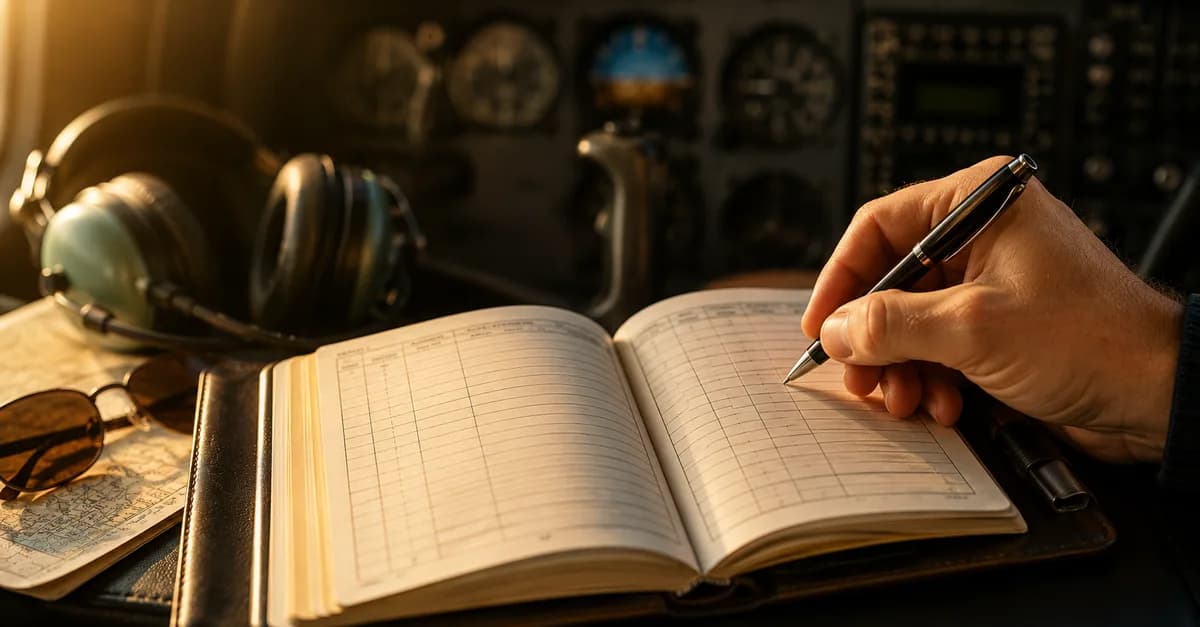
Use an electronic logbook from day one. Know exactly which columns need filling. At every debrief, ask: "What hours did I log today? What do I still need?"
Don't wait until you're 10 hours short of a requirement to discover a gap in your record-keeping.
Back to blog